As we mark 13 years of the 8012 FinTech Design Center, I find myself reflecting not just on 2013,

As we mark 13 years of the 8012 FinTech Design Center, I find myself reflecting not just on 2013, but on a journey that began around 2009, when we were asking a fundamental question at Polaris: how do we transform from a services organisation into a Product and Technology Institution…to be agenda setters.

Between 2009 and 2011, we initiated the Unmukt program to understand the art & science of human thinking, engaging over 1100 associates. While it created energy, the impact was not as enduring as we had expected and that was a defining learning, as it made us realise that thinking cannot be transformed through programs alone, but requires a continuous environment.

This led to the creation of the Design Center as an Inspirational Space, where thinking could be experienced through persona maps, empathy maps, patterns and anti-patterns, and by connecting the dots. The Center took nearly 15 months to design, with multiple iterations, and another 9 months to build.

When it came alive in 2013, it marked a shift in how we approached problems and contributed to the evolution of Intellect Design Arena Ltd in 2014 as a Product and Technology Institution.

Organising the Thinking Space We learnt that transformation begins with organising the thinking space, because most challenges arise not from lack of intelligence, but from lack of structure in thinking. By bringing structure across imagination, learning, performance, effectiveness, influence and contribution, we moved from reactive to designed thinking.

Expanding the Performance Space As thinking became organised, it led to expanding the performance space, where we moved beyond incremental problem solving to applying First Principles Thinking and questioning the fundamentals of systems and complexity.

Impacting Business Outcomes through Design Thinking When thinking is organised and performance is expanded, the outcome is measurable business impact. This is reflected in platforms like eMACH.ai and Purple Fabric, which are outcomes of applying Design Thinking as a discipline to solve complex enterprise problems.

Over the last 13 yrs, more than 1lakh people have experienced the Center, and the real impact has been in how it has helped individuals/ institutions rethink their own thinking.

Design with AI The next phase is about extending Design Thinking into the era of AI, where the focus is on designing intelligence that is precise, contextual and capable of delivering real business outcomes. Through Purple Fabric, with participation from global institutions, we are moving towards Business Impact (Precision) AI

As we enter this next phase, I would leave you with a question, and I would be keen to hear your thoughts:

Are we still experimenting with AI, or are we truly using it to create measurable business impact? Where do you see your organisation today?


March 11, 2026

Mission Samriddhi at 10: From Designing Dreams to Scaling Village Surplus

The next Silicon Valley will not be a city.
It will be a valley of villages.

This is the belief with which we started Mission Samriddhi ten years ago.

At Mission Samriddhi Summit 10 which is happening now in Chennai (26 – 28 Feb), I began with a simple question:

What truly transforms a civilisation?
Is it technology?
Is it capital?
Or is it something deeper?

History gives us a clear answer.

Technology existed long before modern economies. The real shift happened when societies learned how to organise thinking and community.

In 1602, the East India Company became the first publicly listed company in the world. Its real innovation was not ships or trade routes.

Its real innovation was organised surplus people investing together and sharing the value they created.

In the 1700s, Edinburgh, a town of less than 200,000 people became a centre of global innovation because thinkers met, debated and built ideas together.

France and Switzerland later showed that design, precision and brand can create enduring prosperity even without natural resources.

Then came Silicon Valley once a desert.

They took sand and turned it into silica to build chips that power the modern world.

When I visited the Satpura Valley in Betul, I asked myself a simple question:

If Silicon Valley can emerge from a desert, why can Satpura not emerge from a village economy?

Because the real resource is not land.

The real resource is thinking.

And if thinking is a resource,

It can be designed.
And if it can be designed – it can be scaled.

Mission Samriddhi was built on one simple conviction:

Rural development must begin with aspiration, not subsidy.

Villages must not survive on external capital.

Villages must create and retain their own surplus.

To make this possible, we built the 10 Pillars of Change:

1. Dream Activation– helping teenagers see themselves as creators, not job seekers.

2. Confidence through Creation–building the belief that value can be created locally.

3. Engineering Literacy– teaching youth to maintain and repair local technology.

4. Business Literacy –making village income, expenses and trade deficits visible.

5. Precision Farming –thinking in inches instead of acres to increase productivity.

6. Value Addition –processing and packaging products within the village.

7. SHGs as Startups–transforming self-help groups into professionally governed enterprises.

8. Technology and AI –giving rural youth access to the same knowledge as the world.

9. Design and Branding –creating brand surplus from village products.

10. Replicable Models –building enterprises that can scale across districts.

Over the last decade we have moved from Dream to Design.

Mission Samriddhi Summit 10 marks the shift from Design to Scale.

When villages generate surplus, Young people stop seeing the village as an exit point.

A place where they can become creators, entrepreneurs and leaders.

Civilisations are not built by resources. They are built by organised thinking.

February 23, 2026

India AI Summit: From AI Capability to Trust

India AI Impact Summit #2

THE WORLD HAS ENOUGH AI.
WHAT IT LACKS IS AI IT CAN TRUST.

Following my previous reflection, several enterprise leaders continued the conversation with a question that I think captures the current moment in AI: “If capability is advancing this fast, why are organisations still cautious about using AI for consequential decisions?”

It is a fair question.

We are seeing extraordinary progress in models, infrastructure, and scale. AI today can analyse, predict, and recommend with remarkable speed. Yet when decisions carry consequence – credit approvals, compliance enforcement, healthcare recommendations, policy execution – hesitation appears. Not because organisations doubt intelligence.

But because they are unsure about reliability.

At the point of consequence, most AI systems remain probabilistic. That works for assistance and exploration. But enterprise decisions require judgment that is accountable, governed, and dependable. Statistical confidence alone is not enough when outcomes must be defended.

We are entering a new phase of the AI era where the constraint is no longer capability. It is trust architecture.

Enterprises do not simply need bigger models; they need structures that translate intelligence into reliable decisions. AI must evolve from being impressive to being dependable.

This belief shaped our work on Purple Fabric, a judgment layer designed to sit above AI capability. Grounded in first principles thinking, it focuses on converting probabilistic intelligence into accountable decision infrastructure. Through deterministic knowledge grids, context-bound reasoning, and reliability governance, the architecture is built to support decisions that are explainable, auditable, and repeatable.

The shift is subtle but fundamental:
from capability to authority,
from intelligence to judgment.

In the long run, AI will not scale where it is smartest. It will scale where it is trusted.

As we participate in the India AI Impact Summit, I look forward to continuing this dialogue with business leaders and policymakers on how enterprises can move from experimentation to reliable AI infrastructure and how India can help shape trustworthy AI at global scale.

February 16, 2026

Beyond the 80% Plateau: Why Accuracy is the Final Frontier for Enterprise AI

India AI Impact Summit#7

AI BECOMES REAL ONLY WHEN ACCURACY
BECOMES NON-NEGOTIABLE.

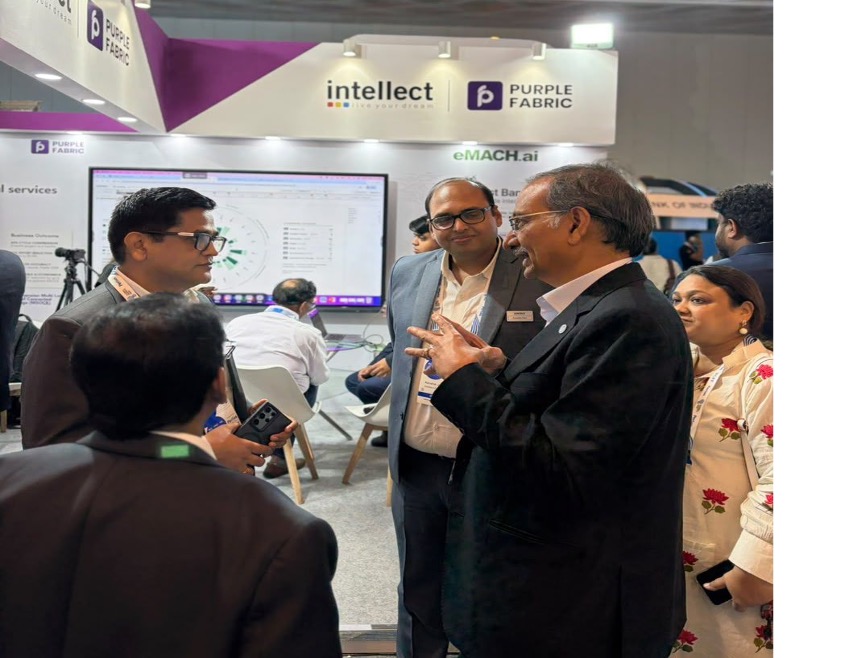
Today at the India AI Impact Summit, as we walked leaders through the Purple Fabric stall, one idea kept surfacing in every conversation:

In a lab, 80% accuracy feels impressive.
In an enterprise, 80% accuracy becomes operational risk.

Institutions do not run on “mostly right.”

They run on decisions that must stand up to audit, regulation, and consequence.

That is the boundary between experimental AI and business impact AI. When we stepped back and applied first principles thinking, the question was not how to make models faster. The question was: how does judgment actually work?

Human intelligence is a triad – knowledge, reasoning, and context. Expertise alone does not produce reliable outcomes. Perspective shapes interpretation. Behaviour under uncertainty determines consequence. If any one dimension weakens, judgment weakens.

This is why enterprises keep hitting the same plateau.

It is not a compute ceiling. 
It is an architecture ceiling.

From a design thinking lens, we began with empathy: how institutions actually function. Organisations are not datasets. They are living systems built on tacit knowledge, governed workflows, and shared decision memory. AI must integrate into that fabric – not sit above it.

That belief led us to architect Purple Fabric as governed enterprise infrastructure.

At the summit, we launched Enterprise AI on Tap – designed to move enterprises beyond the 80–85% reliability plateau and engineer 95%+ enterprise-grade accuracy as the baseline for production. This is not achieved by optimism. It is achieved by design – by combining deterministic knowledge discipline, orchestrated reasoning, and explicit context enforcement, all governed within an enterprise-ready framework.

Industry observers increasingly note that the next phase of AI adoption will hinge on trust and governance, not pure model capability. Enterprises do not hesitate because AI is weak. They hesitate because AI must earn the right to act. Purple Fabric is built around that principle.

As global accountability and regulatory frameworks evolve, architectures that embed reliability at the design level will become strategically central – because in the end, AI will scale not where it is most fluent, but where it is most defensible.

If you are at the India AI Impact Summit (Feb 16–20 | Bharat Mandapam), I invite you to visit the Enterprise AI Design Center and experience what decision-grade enterprise AI looks like when engineered for production.

February 11, 2026

The New Utility: Moving AI from the Innovation Sandbox to the Institutional Backbone

The New Utility: Moving AI from the Innovation Sandbox to the Institutional Backbone

India AI Impact Summit #6

WE HAVE MOVED BEYOND THE ERA OF AI EXPERIMENTATION.
WE ARE ENTERING THE ERA OF AI UTILITY.

Today the India AI Impact Summit opened in New Delhi, and I see this moment as more than an industry gathering. It signals a transition in how intelligence will live inside institutions.

For the past few years, AI has existed largely in sandboxes – pilots, isolated projects, impressive demonstrations. Many organisations have experimented successfully. Yet experimentation alone does not create infrastructure. History reminds us that technology becomes transformative only when it becomes utility.

We do not build our own power grids.
We do not build our own telecom networks.
We rely on systems engineered for reliability, governance, and continuity.

AI is now reaching that same maturity threshold

Enterprises are discovering that fragmented AI projects cannot scale institutional intelligence. What is required is a structural backbone – infrastructure that unifies knowledge, orchestrates expertise, and embeds governance into everyday decision-making.

And this is where AI stops being a technology conversation and becomes a cultural one.

AI adoption is not simply about deploying models. It is about redesigning how organisations think, collaborate, document knowledge, and share judgment. When intelligence becomes infrastructure, behaviour changes. Decision flows change. Accountability becomes explicit. Culture evolves.

That cultural transition is what determines whether AI remains experimental or becomes foundational.

At the summit, we are presenting Enterprise AI on Tap – Purple Fabric – built around the idea that enterprise intelligence should function as governed infrastructure. Not a personal productivity layer. Not a collection of disconnected tools. But a unified platform that allows organisations to architect digital expertise, orchestrate intelligent agents, and embed reliable intelligence directly into their operating systems.

Each of our previous digital waves expanded participation. The internet connected India. Mobile mobilised India. Digital payments formalised economic inclusion. AI now has the potential to expand institutional capability at population scale.

India is uniquely positioned not just to adopt AI, but to design how it becomes infrastructure – governed, inclusive, and reliable. This is not simply an industry opportunity. It is an architectural opportunity at national scale.

We are participating in a big way at the India AI Impact Summit (Feb 16–20 | Bharat Mandapam). If you are attending, I invite you to visit the Enterprise AI Design Center and experience how enterprise intelligence can be built responsibly, accessibly, and at production scale.

Because the next phase of AI will not be defined by demonstrations. It will be defined by infrastructure.

And infrastructure, ultimately, shapes culture.

February 9, 2026

The Voice of Sonbhadra: How Tribal Students and SHG Women are Using AI to Disrupt Poverty

The Voice of Sonbhadra: How Tribal Students and SHG Women are Using AI to Disrupt Poverty

AI in Rural India to drive local entrepreneurship not Just Skill Development

ChaGPT Chacha – Gemini Mami

Ask any question for which you could not get answer from Chacha or Mami.

These AI under intellect Purple Fabric initiative we have introduced in Sonbhadra, Most backward District in UP for school during Ullas Tinkerfest.

We have introduced AI to participants of Tinkerfest from class 7th to 10th standard from underprivileged tribal communities. Anil Pradhan, CEO Young Tinker Academy ask the question – you can ask any question from the Mike in Hindi and most difficult question from ChaGPT Chacha or Gemini Mami and it will answer your question.

They felt thrilled and started asking difficult questions.

Now the ladies sitting in the audience also understood the power of AI. They mentioned can they write applications and emails. Then they tried writing applications to District magistrate or collector etc. Obviously now Women has a voice and an ‘Smart executive assistant’ to solve their rural problems. They knew their problems but did not know how to express them.

Next SHG women in the group started asking the question that they make Millets products or soap or Snacks. How can AI help them to market the product in near market – Reningutta or Varanasi. They also ask ChatGPT Chacha and Gemini Mami to suggest names of the products.

Next They also got the logo designed from Chacha at free of cost.

Now we will be starting Startup Seed fund of 10,000/- per team who wants to start Startup for 10 teams today.

It’s model of Rural School Incubator, SHG business design and Community Voice.

December 9, 2025

Design Thinking. Systems Thinking. Human Thinking – The Journey of Mission Samriddhi.

Foundation Day of Mission Samriddhi 

On 12th November 2016, a small meeting of around 25 people at the Design Center laid the foundation for what would become a large family of True Rural Transformation Catalysts.

Each interaction with the Mission Samriddhi community continues to humble me – the depth of knowledge, width of experience, and height of commitment that each of you brings is truly inspiring

Over these years, we have conducted Design Thinking workshops across five dimensions of holistic development – Personal, Social, Economic, Ecological, and Institutional. Through First Principles Thinking, we uncovered core issues, and by applying Systems Thinking, we built repeatable and scalable models for transformation

To me, Mission Samriddhi is a Living University of Humanity – it teaches me something new every single week. In these nine years, not one week has passed without learning, reflection, or inspiration from this collective.

As we often say, we don’t thank our family members – yet today, I want to express my deep gratitude to all of you – my teachers, collaborators, and fellow contributors – for walking together on this journey to make the world a better and more humane place.

November 13, 2025

Tamil Nadu has always fascinated me

A land that has given the world philosophy, mathematics, and trade centuries ago is today emerging as one of the most vibrant startup ecosystems in India.

When I look at the young entrepreneurs here, I ask myself – what makes a startup resilient in today’s disruptive world? Is it the funding they raise, the technology they adopt, or the markets they enter? Or is it something deeper – the ability to design intelligence into the very DNA of the enterprise, so that it adapts, learns, and endures?

AI is changing the world around us at an unprecedented pace. Yet, AI by itself is not the answer. Left unguided, it can amplify complexity, bias, and mistrust. The real challenge is – how do we combine human empathy with AI’s power to create enterprises that are both profitable and purposeful?

This question has shaped my own journey. It is what led us to experiment with embedding design and governance into AI and over time, it became part of our Purple Fabric: intelligence that is designed for business impact, not by accident.

In Tamil Nadu, this question takes on a larger dimension. We are not just talking about unicorns in metros. We are talking about inclusive entrepreneurship – women founders, rural innovators, deeptech dreamers – coming together to redefine the state’s economic and social fabric. Can Tamil Nadu, with its heritage and hunger, become one of the world’s top 20 startup destinations by 2032? I believe it can. And in doing so, it can offer a model of growth that is both global and deeply rooted in human values.

As I prepare to share thoughts at the Tamil Nadu Global Startup Summit 2025 organised by StartupTN tomorrow, 9th Oct on “Designing Intelligence: Building Resilient Enterprises in a Disruptive World”, I am looking forward not just to speaking, but to listening. Because every founder’s story is a lesson, and every disruption is an opportunity to reflect on how we can build enterprises that stand the test of time.

What do you think makes an enterprise truly resilient – technology, funding, or the design of intelligence at its core?

Government of Tamil Nadu MK Stalin Intellect Design Arena Ltd School of Design Thinking Mission Samriddhi STPI-Chennai P Thiaga Rajan

October 21, 2025

Travel to Dubai for the launch of Intellect’s ‘First Principles’ Technology suite

My interactions proved to be incredibly enriching. I had the privilege of meeting the COOs and CIOs of three major banks in the UAE, gaining first-hand knowledge about their current strategies. I was particularly impressed by their operational efficiency, evident in their high net margins (around 60%) and low cost-to-income ratios (between 25 and 32%).

Beyond business, I was captivated by the speed of change of the region. The drive from Dubai to Abu Dhabi, a mere 1 hour 10 minutes at 140 km/hour (87 mph) much higher than speed limit of 65 mph in US. I like the way the green trees are planted along the highway with drip irrigation in complete desert.

In Abu Dhabi, the “richer and older brother” of Dubai, I met with a customer of ADIB and engaged in a stimulating discussion about applying first principles thinking.
I could able to visit few Tourist structures built in Abu Dhabi : the Louvre Museum, Qasr-a-watan and the Grand Mosque. All 3 structures are big in size as well with great craftsmanship.

What I liked about the trip that Human can reverse the direction of desertification if they want. I noticed vegetables and fruits from local farms that too in the Desert of the UAE and they were using all bio fertilisers.

Rajesh Saxena Rajeev Kakar Sandeep Chouhan Banesh Prabhu Manish Maakan

March 1, 2024

First Principle Design eMACH.ai anniversary

IntellectAI, leveraging advanced technologies such as NLP, Computer Vision, and Big Data, has successfully tackled the challenge of extracting contextual intelligence from complex documents set. This innovative approach, employing proprietary domain-specific models, algorithms, and GenerativeAI, has paved the way for developing DIMS – Document Intelligence Management System. iFABRIC DIMS Platform is solving four frames of mystery.

Frame 1 : Document Classification
Frame 2 : Document Extraction
Frame 3 : Extracted data Accuracy and Validation
Frame 4 : Enriched Decision Grade data

Currently, many Fintech companies are solving each use case separately similar to early stage RDBMS companies during 1980 to 1990s era. Since my 37 years in Banking industry, I believe Banks need trusted and Integrated platform on which multiple Contextual experiences can be designed like Autonomous Credit underwriting, Large interdependent data of Trade financing, Right and compliant advise for HNIs, Embedded AI Agents to streamline operations, complex GRC alerts and embedded compliance during customer advise/ risk reporting.

All the above use cases are interdependent and require a designed approach to build a cohesive Cognitive Enterprise.

At eMACH.ai anniversary, our iFABRIC platform has won over 18 mandates from global P&C insurance, Wealth, and Investment banks and large corporates. We are running ‘Proof of Impact’ in over 40 progressive customers as of now.

I must congratulate the IntellectAI team, who applied the first principles of design thinking to demystify complex 51 step AI use case design process to just 5 step Algorithm for creating Business Impact embedded AI.

Intellect Design Arena Ltd Banesh Prabhu Deepak Dastrala Hari Menon Laila Beane Sandeep Tandon

hashtag#IntellectAI #eMACH.ai hashtag#FirstPrincipleDesign hashtag#iFABRIC hashtag#Success hashtag#IntellectAI

February 1, 2024