-
Business decision and a safely delivered change
I was sitting with a CIO of a large bank, and he asked a simple question: “If claude/cursor/Codex can already write code and generate tests, why do we need MSOCK?”
It is a fair question. My response begins with another question:
What happens between a business decision and a safely delivered change in a bank?
Consider changing a payment cut-off rule.
Writing the code is one part. The team must also understand the existing rules, identify affected customer journeys, trace dependencies across payments and ledgers, assess compliance implications, select regression tests, and prepare operations for release.
Faster code generation helps. Delivery also depends on how quickly and reliably the enterprise can answer these questions.That is the distinction between accelerating software development and improving the entire Product Delivery Lifecycle.
We are building MSOCK as an enterprise AI infrastructure layer that makes enterprise knowledge computational.
Its five engines connect understanding to execution:
– SOCK connects knowledge across business, operations and technology.
– Spatial makes that knowledge and its relationships visible.
– Accurate Blast Radius identifies the dependencies and consequences of a proposed change.
– Autonomous Engineering uses that context to support execution.
– Governance provides a Command Center for oversight, evidence and control.The value proposition is to reduce repeated discovery, loss of intent across handoffs, uncertain impact assessments and rework throughout delivery.
MSOCK coexists with copilots, agents and models, giving them connected enterprise context.
RDBMS made data computational.
MSOCK makes enterprise knowledge computational.For CIOs and GCC leaders, the measure of success must extend beyond code produced:
We have experienced a 50% reduction in business intent-to-production and a 60% reduction in effort.Build. Run. Change. Modernise.

-
My Diary – Principle based City Design
Walking through Manhattan today, I was struck by how a decision taken in 1811 still shapes the city’s everyday life. The Commissioners’ Plan laid out 155 numbered streets and 12 avenues across much of what was then rural Manhattan.
Principles based design
Principle 1: Avenues 100 ft wide
Principle 2: Streets 60 wide and one street 100 ft after every 8-10 streets
Principle 3: Each block is 200 ft by 600 to 950 ft. Based on avenues length.
Principle 4: Each property block 25ft by 100 ft. In Chennai city design the plot size was 40 ft by 60 ft called ‘one Ground unit’.
It was surprising that all skyscrapers came by consolidating small plots into big spaces of today. I can see many original houses existing on 25 ft by 100 ft spaces.
I may be wrong in my interpretation. New Yorkers please correct me.
Interesting city design based on principles rather than evolution which helped NY to become Long lasting design, vibrant economic global hub and catering to Civilisational growth after 200 years.
-
Economic Times Recoginition
We always believed that Purple Fabric is truly Business Impact enterprise AI platform with 8 Engineering stacks
Data & Integration Engineering
Knowledge Engineering
Digital Expert Engineering
Experience Engineering
Security Engineering
Governance & Evaluation Engineering
Runtime & Operations Engineering
AI FinOps & Value Engineering
The platform where entire enterprise create their own Digital Twins driving double the Thruput.

Economic Times recognition has stamped that Superiority.
-
Super Chennai Arattai Show
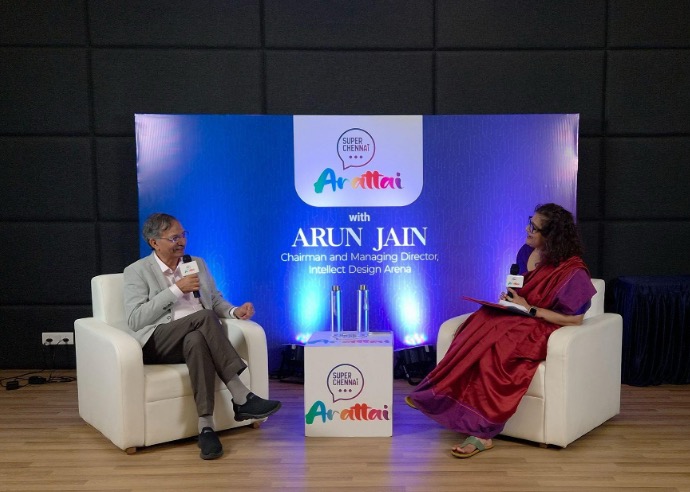
I enjoyed the wonderful chat with Akhila on why did I choose Chennai as a place for building World disrupting tech research which led to full Financial stack eMACH, Purple Fabric – The enterprise AI platform and MSOCK for changing the world without coders.
Very beautifully dialogue.
-
Major Breakthrough
MSOCK adds a Connected and Contextual Knowledge layer to Anthropic Claude Code for Financial Services. MSOCK makes an end of Coding as we know it and reduces the software development effort by one-third.
Purple Fabric research team worked with the Deep Domain Intellect Research team to create a Multi-Dimensional Multi-Layer System of Connected Knowledge(MSOCK) to help system designers, business analysts, and consultants to convert their intent into a fully coded application.
MSOCK layer creates an opportunity to convert billions of dollars in investment that financial institutions have made into 3X productivity by its 5-engine technology stack. MSOCK coexists with Claude code and Cursor. It adds a 4th layer, i.e., the Enterprise trusted Knowledge layer to the AI architecture.
MSOCK launched internally for over 141 projects since the breakthrough in May and brought a 21 Dimensional Living Spatial map of software applications like a GPS, to accurately calculate the blast radius of any innovation or regulatory change. MSOCK also comes with 4 types of CNC machines – MSOCK Build Machine, MSOCK Run Machine, MSOCK Change Machine, and MSOCK Modernise Machine—with a complete Command Center.
Launched at GFF, we have received more than 200 enquiries for next-stage dialogue in just 3 days.
For more information on MSOCK, you can visit https://lnkd.in/g2aN98Bh
Intellect Design Arena Ltd, Purple Fabric Anthropic, Claude, OpenAI, NVIDIA, Amazon Web Services (AWS), Microsoft Azure, Jonathan Pelosi, Scott Blanc
-
Global Fintech Fest 2026
Intellect Design Arena Ltd has unveiled MSOCK at Global Fintech Fest2026.
I am at Booth JF5 at GFF, enjoying the response to what we believe is the critical 4th layer of AI-First Banking: GPU Layer. LLM Layer. Data Layer. Knowledge Layer (MSOCK). Application Layer.
The 4th layer, the Knowledge Layer, is the KEY to accurate AI that delivers real business impact.
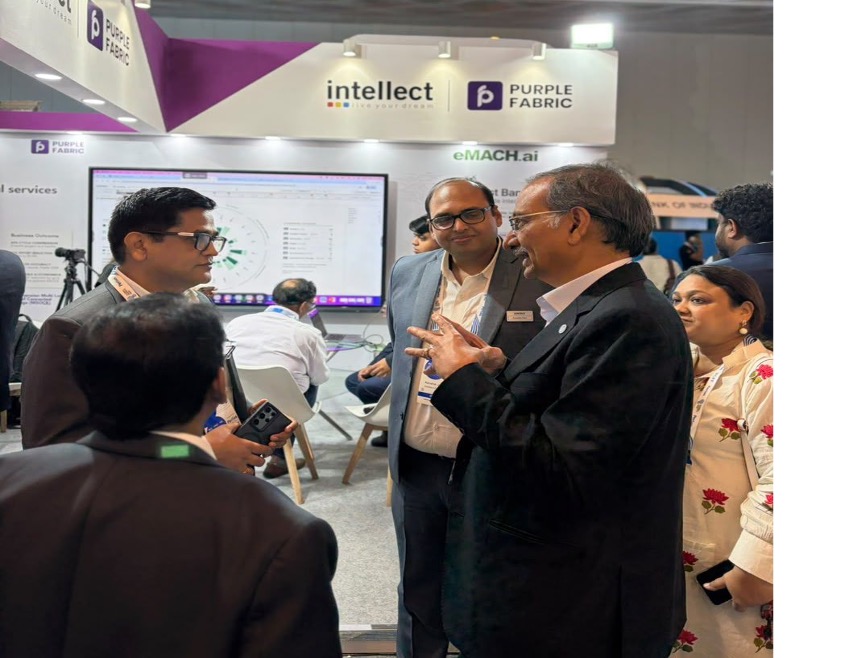
Great conversations at JF5. Looking forward to many more.
ABOUT ME

Hello, my name is Arun Jain. I am a design thinker living in Chennai, India. This is my blog, where I post my thoughts, technology trends and tips about the fintech world and many more.