Bridging timeless knowledge with future-ready leadership.

Bridging timeless knowledge with future-ready leadership.

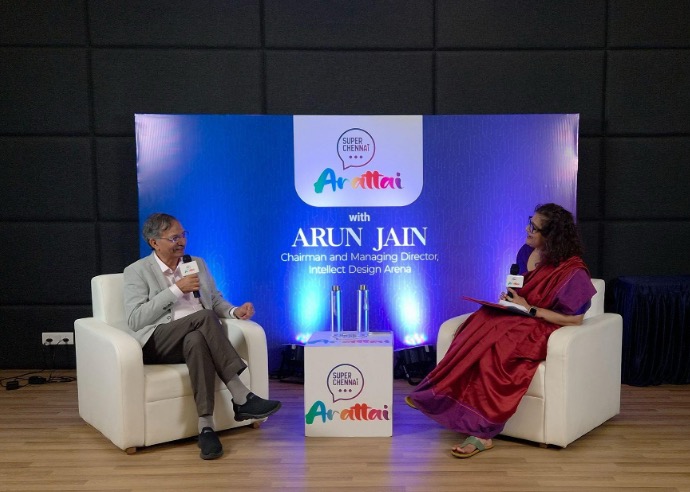
I spoke about Jain System of Knowledge In context of professional world at Jain Acedemy of Scholars yesterday. 

I connected Jain Philisophy and scriptures to 10 layer architecture of perceiving, knowing and intelligence.

In section 2, I connected various layers of System of Knowledge Architecture with four cognitive sciences – Design Thinking, First Principle Thinking, Framework Thinking and System Thinking. 

In section 3, I connected 10 layer SOK with 5 pillars of leadership starting from knowing self, Capacity to think, capacity to act, Concious learning and decision making. 

Section 4 I try to connect in various roles like Mental wellness, entrepreneurship, AI ethics, Sustainability and Digital Behaviour. 

This is the first attempt to connect Ancient Wisdom with Modern Relevance and Future Resposibility. I would like your insights and comments to make it better.

You can view the presentation on The Jain System of Knowledge in this link –

 https://lnkd.in/ggj3Px64

August 5, 2026

The greatest institution we can design is the family

The greatest institution we can design is the family.

My Diary – Family as an institution 

Can there be a design for Family as an institution? 

Few thoughts 

The Seven Designs of an Enduring Family”

The central thesis

Families are not meant merely to coexist. They are meant to create human capability across generations.

Design 1 — Purpose

 Every family needs a shared purpose beyond earning a livelihood.

Output: A Family Constitution.

Design 2 — Relationships

 Relationships are the operating system of the family. 

Build: • Trust, Respect, Listening, Forgiveness, Gratitude, Healthy conflict resolution

Design 3 — Knowledge

 Most families lose their wisdom every generation.

Capture: Stories, Failures, Traditions, Health history

Design 4 — Leadership

Leadership means preparing every generation to make wise decisions.

Teach:Responsibility, Decision-making, Character, Service, Financial literacy, Emotional maturity

Design 5 — Learning

 Families should learn faster than the world changes. 

Suggestion: Annual Family Learning Agenda.

Design 6 — Renewal

 Every generation redesigns the family without destroying its identity.

Renew:Traditions, Roles

Principle: Preserve values. Redesign methods.

Design 7 — Legacy

 The final purpose of a family is contribution.

Legacy includes: Good citizens, Ethical businesses, Community service, Philanthropy

Success is measured not only by family wealth but by societal value.

August 5, 2026

33 Years of Innovation, Trust, and Impact: Celebrating Polaris and Intellect Foundation Day

Celebrating Polaris and Intellect Foundation Day: 33 Years of Innovation, Trust, and Impact:-

33 years ago, we began with a simple belief: technology should create meaningful business impact—not just better software.

Today marks another Foundation Day at Polaris Consulting & Services Ltd and Intellect Design Arena Ltd. It is a moment to reflect on what brought us here, and more importantly, on what lies ahead.

From client-server to the internet, from mobile to cloud, and now AI, technology has continuously reinvented itself. One thing, however, has remained constant: our success is measured by the success of our customers.

That belief led us to design eMACH.ai built on first principles to give financial institutions a truly composable and contextual foundation and Purple Fabric, our open business impact AI platform that transforms intelligence into decisions with measurable outcomes. Yet neither was ever the destination. They exist because we continue to ask ourselves one question:

Will this make our customers stronger, faster and more competitive?

As AI reshapes financial institutions and enterprises across the world, we believe technology alone won’t define the winners. Enduring institutions will.

The organizations that thrive will combine the following:

* Technology with trust

* Innovation with resilience

* Intelligence with responsible execution

That belief is shaping our next chapter. Our aspiration is no longer just to build world-class software – it is to build an enduring institution, guided by seven enduring principles that define how we build, lead and renew ourselves:

  1. Purpose – Relentless focus on customer success
  2. Knowledge – Turning every engagement into institutional learning
  3. Leadership – Nurturing leaders who anticipate change
  4. Learning – Evolving faster than technology itself
  5. Renewal – Redesigning before change demands it
  6. Culture – Startup agility with institutional discipline
  7. Societal Impact – Creating value that extends beyond business into communities

Trust is earned one commitment at a time. To every customer, partner and associate who has placed your trust in us – thank you. You have challenged us to think sharper, move faster and raise our own bar, year after year.

Here’s to remaining curious. Accountable. Innovative. And above all, worthy of that trust.

Happy Foundation Day to everyone who are part of the Polaris and Intellect journey.

The future isn’t simply something we’re building. It’s something we’re designing – together.

Mission Samriddhi Ullas Trust School of Design Thinking

August 5, 2026

The Mathematics of India’s Healthcare Workforce

Continuing on same topic of health care, when can India have 2 doctors per 1000 and 3 doctors per 1000 including Ayush Doctors. 

Two questions

A.Capacity

  1. Serving and reach in Rural india 
  2. Currently india has 1.4 million MBBS and 700,000 Ayush formal doctors. 
  3. ⁠This gives ratio to 1.45 per 1000 in 2026.
  4. ⁠There are 1,36,000 medical seats which has increased from 50,000 seats in 2010. 
  5. ⁠There are 60,000 Ayush Doctor seats in India. 
  6. ⁠Combine one can take 180,000 production capacity per year. 
  7. ⁠For ratio of 2 doctors per thousand we will need 2.8 million doctors. It means we need to add 800,000 new doctors. 
  8. ⁠This means we can achieve 2 Doctors by 2031 or 2032. 
  9. ⁠For 3 doctors ratio, it will take upto 2038 to 2040.

Now the second dimension needs to be considered.

  1. Movement of qualified medical professionals to Villages. 
  2. ⁠In last 30 years, the city data shows the movement is extremely slow. It’s crowding in cities.
  3. ⁠Let me take lead indicators 
  4. The Road access to village has substantially improved in just last 5 years. Thus it is possible to commute to nearest village from Town within 90 minutes to 2 hours. 

B. The construction quality in Village housing as well as infrastructure has substantially improved in last 5 years. Much better in South and West Indian states. 
C. Technology cost of diagnostics machines are coming down and becoming more affordable to setup practice and make them viable.

August 5, 2026

The Future of Healthcare: Learning from Global Benchmarks

India’s Top Healthcare Cities (Approximate Capacity per 1,000 Population)

  • Chennai: 4.2 doctors | 8.5 nurses | 4.2 hospital beds
  • Delhi NCR: 2.9 doctors | 6.0 nurses | 3.2 hospital beds
  • Mumbai: 2.8 doctors | 6.0 nurses | 3.1 hospital beds
  • Kochi: 2.8 doctors | 6.5 nurses | 3.2 hospital beds
  • Bengaluru: 2.4 doctors | 5.0 nurses | 2.4 hospital beds
  • Hyderabad: 2.2 doctors | 4.5 nurses | 2.2 hospital beds
  • Kolkata: 2.2 doctors | 4.5 nurses | 2.4 hospital beds
  • Pune: 2.0 doctors | 4.5 nurses | 2.2 hospital beds
  • Ahmedabad: 2.0 doctors | 4.0 nurses | 2.0 hospital beds
  • Lucknow: 2.0 doctors | 4.5 nurses | 2.2 hospital beds

National Average (India): 1.0 doctor | 2.6 nurses | 1.4 hospital beds per 1,000 population.

Top Global Healthcare Cities (Approximate Capacity per 1,000 Population)

  • Zurich: 5.5 doctors | 21 nurses | 5.0 hospital beds
  • Geneva: 5.5 doctors | 21 nurses | 5.0 hospital beds
  • Munich: 5.2 doctors | 20 nurses | 8.0 hospital beds
  • Boston: 5.0 doctors | 16 nurses | 4.0 hospital beds
  • Paris: 4.5 doctors | 13 nurses | 5.5 hospital beds
  • New York City: 4.0 doctors | 15 nurses | 3.2 hospital beds
  • London: 3.8 doctors | 11 nurses | 2.5 hospital beds
  • Tokyo: 3.5 doctors | 15 nurses | 13.0 hospital beds
  • Singapore: 2.8 doctors | 8.5 nurses | 2.4 hospital beds
  • Seoul: 2.8 doctors | 9.0 nurses | 12.0 hospital beds

August 5, 2026

A Snapshot of India’s Medical Education and Healthcare Capacity

Just doing some research after reading morning news on number of 9900 seats added in medical education system this year. Few startling data points 

Few data points 

  1. ⁠India produce 1.2 lacs doctors per year.
  2. Total registered doctors in India are 14 lacs which translates to 1 doctor per 1000.
  3. The medical seats in India has gone up from 50000 to 136000 per year in last 15 years. 
  4. As per data india has only 4 million nurses ie 3 per 1000.
  5. The world best number of doctors are Cuba with 8 doctors per 1000 and few European countries with 5 doctors per 1000.
  6. US still has 3 doctors per 1000.
  7. The best performing countries have 21 nurses per 1000 while US has 15 nurses and india with just

August 5, 2026

Institution vs. Company: Building for Generations

My Diary – reflections on what is institution vs company.

Institutional Power : The capability to institutionalize excellence by embedding purpose, governance, learning, and renewal into enduring systems that coordinate people effectively and remain relevant across generations.

Enduring Systems – Enduring systems are self-renewing architectures that preserve purpose while continuously regenerating people, knowledge, culture, governance, and resources. 

August 5, 2026

India’s AI Moment: From Adoption to Global Leadership

We have the talent, the entrepreneurial energy, and the digital foundation to move beyond consuming technology to building it for the world.

It was a privilege to join Andy Jassy and fellow business leaders in a thoughtful discussion on AI, innovation, and the role India can play in shaping the next generation of intelligent enterprises.

One idea resonated strongly: AI is no longer about experimentation. The real opportunity lies in translating intelligence into measurable business impact – creating outcomes that improve productivity, decision-making, customer experiences, and human potential.

As we navigate this transformation, First Principles Thinking becomes increasingly important. It challenges us to move beyond incremental improvements and reimagine how businesses are designed, operated, and scaled in an AI-powered world.

The next chapter of AI will not be defined by technology alone. It will be shaped by leaders and organisations that can combine intelligence, purpose, and innovation to create meaningful and lasting impact.

Thank you, Andy, for an engaging and insightful conversation.

August 5, 2026

The Business Impact AI Masterclass in Delhi

I am taking next Business Impact AI – Purple Fabric Masterclass in Delhi on 13th August, Wednesday between 6.00 PM to 8.00 PM at Holiday Inn, Aerocity. I will be covering Human Intelligence vs Artificial Intelligence and how to reimagine customer, products, Operations and Risk using Design Thinking and First Principle Thinking.

I will also be connecting role of Enterprise knowledge – Explicit Knowledge, Implicit Knowledge and Tacit Knowledge using PF – Enterprise Knowledge Garden(EKG) and Enterprise Digital Experts(EDE).

I would like to have a good dialogue with System Integrators – How to enhance your business value Proposition using Purple Fabric, ISV – How to enhance power of embedded AI in your products, GCC – How to embed Digital Experts as API’s in your current business Applications and Enterprise Business managers and CDO – How to reimagine your business and create AI Native Managers within your enterprise using Purple Fabric.

Date: 13th August 2025, Wednesday

Time: 6pm to 8pm

 Followed by dinner & cocktails

Venue: Holiday Inn, Aerocity

Register Now: https://lnkd.in/gdnPXVnY


September 8, 2025

The Business Impact AI Masterclass: Beyond Experimentation

In 2015, I asked my team of 1,200 researchers a simple question:

Can we build an AI platform that doesn’t just predict or automate but actually delivers business impact at scale?

Nine years later, that question has taken shape as Purple Fabric, the world’s first Open Business Impact AI Platform. We formally launched it on 12th May in the Financial Times and on 26th May in The Economic Times in India.

What followed has been nothing short of humbling. In just 60 days, we have hosted over 50 bootcamps and welcomed more than 5,000 participants to the Business Impact AI Masterclass in Mumbai, Bengaluru, South Africa, and virtually across the world.

These conversations are not about AI theory. They are about execution. They are about how leaders can move beyond experimentation and apply AI to:

* Reimagine Customer Experience

* Reimagine Product Innovation

* Reimagine Operational Efficiency

* Reimagine Risk and Compliance

On August 13th, I look forward to continuing this journey in Delhi with forward-looking enterprises (digital, product-led, and service-driven), each exploring how AI can unlock real business value.

We will also discuss the foundational ideas behind Purple Fabric:

* Enterprise Knowledge Garden

* Enterprise Digital Experts, not just agents

* And EnterpriseGPT, built for real, governed outcomes

This Masterclass represents a decade of belief that AI must be grounded in purpose, governed with discipline, and designed to deliver measurable outcomes.

– Holiday Inn, Aerocity, Delhi

– August 13, 2025

– 6:00 PM to 8:00 PM 

Register here: https://lnkd.in/gdnPXVnY

I look forward to an evening of deep exchange, shared learning, and meaningful dialogue.

Because if it doesn’t deliver business impact, it isn’t enterprise AI.

September 8, 2025