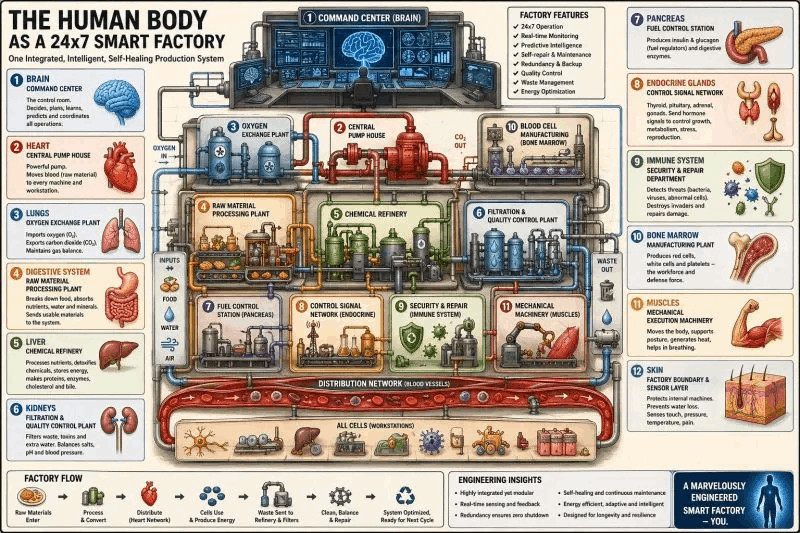
A lot of Precision, fully connected and self-healing enterprise architecture inspiration can befound in human body architecture.

A lot of Precision, fully connected and self-healing enterprise architecture inspiration can be found in human body architecture.

For AI, we need to learn Human Intelligence.

Human Intelligence comes from understanding Systems Thinking operates in the human body.

The attached diagram is a combination of System Thinking and Framework Thinking.

April 21, 2026

Designing Humane Systems: Why the Future of AI belongs to the Architects of Trust

India AI Impact Summit #5

AI IS NOT A FEATURE OF THE DIGITAL AGE.
IT IS A REWRITE OF HOW HUMANS DECIDE.

Over the last thirty years, we have lived through a sequence of quiet revolutions.

The internet expanded access to information.
Mobile expanded access to connectivity.
QR payments expanded access to participation.

Each wave did more than introduce technology. It redesigned behaviour. It widened inclusion. It changed who could belong inside the formal economy.

AI is the next wave- but it is fundamentally different.

It is the first technology that scales cognition.

For the first time, we are not merely digitising transactions or communication. We are designing systems that interact with human judgment itself. And when technology touches judgment, the conversation can no longer remain technical. It becomes philosophical. It becomes cultural. It becomes a design question.

In design thinking, we begin with empathy – not with tools. We ask how humans think, how they consult, how they remember, how they decide under uncertainty. Institutions are not built only on data. They are built on shared memory, tacit knowledge, invisible logic accumulated over decades. If AI ignores this human substrate, it will remain impressive but shallow.

This belief shaped our work on Purple Fabric. We did not approach it as a model project. We approached it as institutional design. A platform where knowledge becomes explicit, decision logic is governed, and intelligence can scale without losing accountability.

At the India AI Impact Summit, we launched Enterprise AI on Tap at an entry point of ₹99,500 per month for 50 users. The intention is not to create another personal productivity layer. It is to democratise enterprise cognition.

Through:

  • Enterprise Knowledge Garden
  • Digital Expert Designer with multi-agent orchestration
  • ISO 42001 certified governance architecture
  • LLM benchmarking and optimisation design

organisations can design digital experts and intelligent agents that plug directly into existing systems as APIs.

AI, in this sense, is not competing with humans.

It is amplifying the collective memory of institutions.

And that is why this moment matters for India.

Every previous digital wave expanded participation. AI can expand capability. Because conversational intelligence does not require literacy, privilege, or specialised access.

We are participating in a big way at the India AI Impact Summit from February 16–20 at Bharat Mandapam, New Delhi. If you are visiting, I invite you to experience the Enterprise AI Design Center and engage in this conversation about how India can lead in building trustworthy, inclusive AI infrastructure at global scale.

Because the future of AI will not be defined by who builds the biggest models.

It will be defined by who designs the most humane systems around them.

February 12, 2026

The New Utility: Moving AI from the Innovation Sandbox to the Institutional Backbone

The New Utility: Moving AI from the Innovation Sandbox to the Institutional Backbone

India AI Impact Summit #6

WE HAVE MOVED BEYOND THE ERA OF AI EXPERIMENTATION.
WE ARE ENTERING THE ERA OF AI UTILITY.

Today the India AI Impact Summit opened in New Delhi, and I see this moment as more than an industry gathering. It signals a transition in how intelligence will live inside institutions.

For the past few years, AI has existed largely in sandboxes – pilots, isolated projects, impressive demonstrations. Many organisations have experimented successfully. Yet experimentation alone does not create infrastructure. History reminds us that technology becomes transformative only when it becomes utility.

We do not build our own power grids.
We do not build our own telecom networks.
We rely on systems engineered for reliability, governance, and continuity.

AI is now reaching that same maturity threshold

Enterprises are discovering that fragmented AI projects cannot scale institutional intelligence. What is required is a structural backbone – infrastructure that unifies knowledge, orchestrates expertise, and embeds governance into everyday decision-making.

And this is where AI stops being a technology conversation and becomes a cultural one.

AI adoption is not simply about deploying models. It is about redesigning how organisations think, collaborate, document knowledge, and share judgment. When intelligence becomes infrastructure, behaviour changes. Decision flows change. Accountability becomes explicit. Culture evolves.

That cultural transition is what determines whether AI remains experimental or becomes foundational.

At the summit, we are presenting Enterprise AI on Tap – Purple Fabric – built around the idea that enterprise intelligence should function as governed infrastructure. Not a personal productivity layer. Not a collection of disconnected tools. But a unified platform that allows organisations to architect digital expertise, orchestrate intelligent agents, and embed reliable intelligence directly into their operating systems.

Each of our previous digital waves expanded participation. The internet connected India. Mobile mobilised India. Digital payments formalised economic inclusion. AI now has the potential to expand institutional capability at population scale.

India is uniquely positioned not just to adopt AI, but to design how it becomes infrastructure – governed, inclusive, and reliable. This is not simply an industry opportunity. It is an architectural opportunity at national scale.

We are participating in a big way at the India AI Impact Summit (Feb 16–20 | Bharat Mandapam). If you are attending, I invite you to visit the Enterprise AI Design Center and experience how enterprise intelligence can be built responsibly, accessibly, and at production scale.

Because the next phase of AI will not be defined by demonstrations. It will be defined by infrastructure.

And infrastructure, ultimately, shapes culture.

February 9, 2026

A Business Impact AI Masterclass for US & Canada leaders

Today, the voices around AI are louder than ever. Every enterprise is being promised transformation. Yet the central question remains: how do we move from pilots and experiments to impact that is real, governed, and delivers measurable business impact?

This question has guided my own journey with AI for over a decade. Purple Fabric, the world’s first Open Business Impact AI Platform, is our response. It is not built to impress, but to serve. Not designed to predict alone, but to deliver outcomes that matter at scale.

The journey so far has been extraordinary. More than 50 bootcamps. Over 5,000 participants across Mumbai, Bengaluru, Delhi, South Africa, and global virtual sessions. And the focus has always been clear – not theory, but execution. How leaders can apply AI to reimagine:

– Customer Experience

– Product Innovation

– Operational Efficiency

– Risk and Compliance

On September 10, 2025, I invite you to join me for our next Business Impact AI Masterclass, designed for leaders in the US & Canada. In this session, we will go deeper into not only use cases but the core design principles behind Purple Fabric:

– Enterprise Knowledge Garden – connecting and nurturing enterprise-wide intelligence

– Enterprise Digital Experts – moving beyond agents to true specialists

– EnterpriseGPT – governed and designed for real-world outcomes

For me, this is more than a technology journey. It is the discipline to design with purpose, the belief that governance is essential, and the responsibility to ensure AI delivers measurable business impact.

– Session designed for leaders in the US & Canada

– Sep 10, 2025 – 11:00 AM – 12:30 PM EST / 8:00 AM – 9:30 AM PST

– Register here: https://lnkd.in/g4DRqeZd

Because in the enterprise world, if AI does not deliver measurable outcomes, it does not belong.

September 18, 2025

Travel to Dubai for the launch of Intellect’s ‘First Principles’ Technology suite

My interactions proved to be incredibly enriching. I had the privilege of meeting the COOs and CIOs of three major banks in the UAE, gaining first-hand knowledge about their current strategies. I was particularly impressed by their operational efficiency, evident in their high net margins (around 60%) and low cost-to-income ratios (between 25 and 32%).

Beyond business, I was captivated by the speed of change of the region. The drive from Dubai to Abu Dhabi, a mere 1 hour 10 minutes at 140 km/hour (87 mph) much higher than speed limit of 65 mph in US. I like the way the green trees are planted along the highway with drip irrigation in complete desert.

In Abu Dhabi, the “richer and older brother” of Dubai, I met with a customer of ADIB and engaged in a stimulating discussion about applying first principles thinking.
I could able to visit few Tourist structures built in Abu Dhabi : the Louvre Museum, Qasr-a-watan and the Grand Mosque. All 3 structures are big in size as well with great craftsmanship.

What I liked about the trip that Human can reverse the direction of desertification if they want. I noticed vegetables and fruits from local farms that too in the Desert of the UAE and they were using all bio fertilisers.

Rajesh Saxena Rajeev Kakar Sandeep Chouhan Banesh Prabhu Manish Maakan

March 1, 2024

First Principle Design eMACH.ai anniversary

IntellectAI, leveraging advanced technologies such as NLP, Computer Vision, and Big Data, has successfully tackled the challenge of extracting contextual intelligence from complex documents set. This innovative approach, employing proprietary domain-specific models, algorithms, and GenerativeAI, has paved the way for developing DIMS – Document Intelligence Management System. iFABRIC DIMS Platform is solving four frames of mystery.

Frame 1 : Document Classification
Frame 2 : Document Extraction
Frame 3 : Extracted data Accuracy and Validation
Frame 4 : Enriched Decision Grade data

Currently, many Fintech companies are solving each use case separately similar to early stage RDBMS companies during 1980 to 1990s era. Since my 37 years in Banking industry, I believe Banks need trusted and Integrated platform on which multiple Contextual experiences can be designed like Autonomous Credit underwriting, Large interdependent data of Trade financing, Right and compliant advise for HNIs, Embedded AI Agents to streamline operations, complex GRC alerts and embedded compliance during customer advise/ risk reporting.

All the above use cases are interdependent and require a designed approach to build a cohesive Cognitive Enterprise.

At eMACH.ai anniversary, our iFABRIC platform has won over 18 mandates from global P&C insurance, Wealth, and Investment banks and large corporates. We are running ‘Proof of Impact’ in over 40 progressive customers as of now.

I must congratulate the IntellectAI team, who applied the first principles of design thinking to demystify complex 51 step AI use case design process to just 5 step Algorithm for creating Business Impact embedded AI.

Intellect Design Arena Ltd Banesh Prabhu Deepak Dastrala Hari Menon Laila Beane Sandeep Tandon

hashtag#IntellectAI #eMACH.ai hashtag#FirstPrincipleDesign hashtag#iFABRIC hashtag#Success hashtag#IntellectAI

February 1, 2024

Post on Seatle visit update

efficiency built in 1961.

The middle floor of the tower rotates to give 360 degree view. Obviously entire floor with few hundred people has weight of over 125 Tons. This floor rotates with just 1.5 Horse Power(HP) motor. The home mixer has motor of 1.0 HP to 2.0 HP.

What a High Performance Design more than 60 years ago!!!

August 1, 2023

Conducting session for All India Council of Technical Education AICTE

I conducted the session with 24 leaders of All India Council of Technical Education(AICTE) yesterday. The entire team travelled to Intellect design Center from Delhi and other cities to attend this 2 day workshop.

I love the enthusiasm and zeal for learning during the session. They took out their weekend to learn. I love the questions they were curious to ask.

I think that’s the change we are looking in Engineering and management education under the leadership of Anil sahastrabuddhe, where administrators are first learning hands on before introducing Design Thinking as a course in all engineering and management education.
#leadership #design #engineering #engineering #management #education #designthinking #aicte #intellect

June 10, 2022

The Pixar Story

I watched ‘The Pixar Story’ on Disney+ Hotstar. The 90-minute movie is very inspirational on how they completely changed the animation industry.

The power of human genius and commitment! I did not know George Lukas of Star Trek fame was also behind it.

They produced 7 movies in a row that redefined the creativity in animated movies:
1. The Toy story
2. A Bug’s Life
3. Toy Story 2
4. Monsters Inc
5. Finding Nemo6. The Incredibles
7. Cars

Highly recommended!
Obviously, many educators used movies as a tool to ‘inspire natural learning’ among their students. We as a leader in the industry are educators in many ways. We inspire our employees and customers and must have used some movies; like I use old Hindi movies ‘Bawarchi’ of Rajesh Khanna fame to explain the Power of Influence or #servantleadership etc.

I would like to invite your stories where you used such movies to inspire and accelerate learning. I want to compile the repertoire of various real-time experiences.

#learning #creativity #education #movies #educators #harvard #oxford #iimahmedabad #iimcalcutta #iimb #wharton #parsons #stanforduniversity #insead

May 12, 2022

Panchayats – the hidden lever of accelerated holistic development

I grew up with the assumption that ‘Panchayat’ consists of 5 ‘Panchs’ and 1 ‘Sarpanch’. Their function is linked more with judicial case resolution of the villages.

I learnt about the real purpose of a Panchayat in 2016 after studying the constitution. A Panchayat is equivalent to a local governance body as per all other countries. There are more than 900 million people who come under its governance and thus it holds a key for holistic development of a country. It consists of 11 to 17 wards members.

1. A ward member is the elected member for 100 to 500 families. He is responsible for developments at the smallest unit levels.
2. Sarpanch is also known as the President of the Panchayat in a few states like Kerala.
3. A Panchayat is responsible for preparing its development plan and they have to submit it in the Panchayat portal. The Panchayat gets a direct funding as per development plans submitted to their accounts.
4. A Panchayat also has the power to levy local taxes or sell forest produce in tribal areas to generate their own sources of revenues. The larger Panchayats near the cities get housing society local taxes as well as professional taxes. They are substantially richer Panchayats compared to remote Panchayats.
5. National Institute of Rural Development and Panchayati Raj (NIRDPR) is a central body for the capability building of Panchayats.
6. Mission Samriddhi has launched the ‘India Panchayat Forum’ to work on development at grass root level.
7. CDP – Cluster Development Program designed by MS has 7 frames for the development of Panchayats.
– D1 – Personal Development (Leadership development, Self-belief, Visualisation)
– D2 – Social Development (Education, Health, Infrastructure, Social Justice, Equality)
– D3 – Economic Development (Agricultural, Allied services, SHG, FPOs, Financial and Digital literacy etc)
– D4 – Ecological Development (Water, Soil, Forest)
– D5 – Gram Panchayat Development Plans (GPDP) education and planning including low cost/no cost plans
– D6 – Monitoring and Governance
– D7 – Stakeholder management
8. Mission Samriddhi works with sectoral experts as well as Development Accelerators (NGOs, Corporates and Governments) to drive CDP at various district levels. The fellows on-ground facilitate continuous education and nudging at the Panchayat level.

Today is National Panchayat Day. I invite few corporates along with their employees to celebrate, connect and catalyse Panchayats. You can write to me or Ram at Ram.Pappu@intellectdesign.com

#localgovernment #designcommunity #leadership

April 12, 2022