May 5, 2026

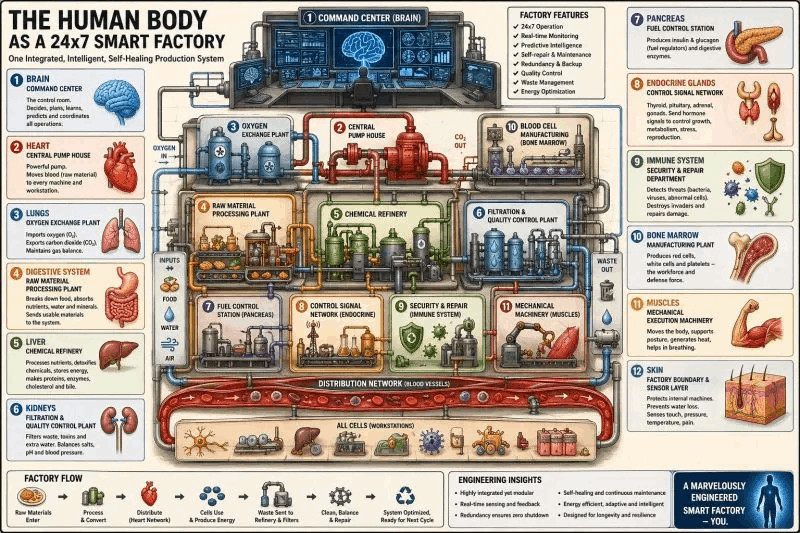
A lot of Precision, fully connected and self-healing enterprise architecture inspiration can befound in human body architecture.

A lot of Precision, fully connected and self-healing enterprise architecture inspiration can be found in human body architecture.

For AI, we need to learn Human Intelligence.

Human Intelligence comes from understanding Systems Thinking operates in the human body.

The attached diagram is a combination of System Thinking and Framework Thinking.

April 21, 2026

Over the last few years, we have been working towards making innovation more systematic.

Over the last few years, we have been working towards making innovation more systematic.

Not occasional breakthroughs, but a way of consistently translating ideas into outcomes.

I am delighted to share that we have filed our 36th patent application for Purple Fabric – the Precision Business Impact AI Platform. And during the year, Intellect has filed over 100 patent applications. We are seeking patent protection not just in India but in major Global markets.

These are not just numbers.

They reflect a system we have been consciously building.

A system where research, legal, product and engineering teams come together to continuously identify, articulate and protect ideas. What I often refer to as a patent factory.

This has been enabled by a research team of 1200 technologists, with over 100 inventors already documented and many more who will emerge through this journey.

Alongside this, we have built a strong product creation capability, where these ideas are translated into real enterprise platforms.

This combination matters.

Because innovation is not just about thinking. It is about building, validating and scaling.

Purple Fabric represents this shift. From AI as automation to AI as Precision Business Impact. Where intelligence is embedded into enterprise workflows to deliver measurable outcomes.

Innovation, when approached with discipline, can be made repeatable.

My congratulations to all the inventors and teams who are part of this journey.

March 25, 2026

36 Patents for Purple Fabric: Engineering the Future of Precision AI

Over the last few years, we have been working towards making innovation more systematic.

Not occasional breakthroughs, but a way of consistently translating ideas into outcomes.

I am delighted to share that we have filed our 36th patent application for Purple Fabric – the Precision Business Impact AI Platform. And during the year, Intellect has filed over 100 patent applications. We are seeking patent protection not just in India but in major Global markets.

These are not just numbers.

They reflect a system we have been consciously building.

A system where research, legal, product and engineering teams come together to continuously identify, articulate and protect ideas. What I often refer to as a patent factory.

This has been enabled by a research team of 1200 technologists, with over 100 inventors already documented and many more who will emerge through this journey.

Alongside this, we have built a strong product creation capability, where these ideas are translated into real enterprise platforms.

This combination matters.

Because innovation is not just about thinking. It is about building, validating and scaling

Purple Fabric represents this shift. From AI as automation to AI as Precision Business Impact. Where intelligence is embedded into enterprise workflows to deliver measurable outcomes.

Innovation, when approached with discipline, can be made repeatable.

My congratulations to all the inventors and teams who are part of this journey.

March 25, 2026

One of the most important shifts we are witnessing today is this.

One of the most important shifts we are witnessing today is this.

AI is not about automation. AI is about reimagining the future.

And if that is true, then education itself must be reimagined.

As we mark the 13th anniversary of the 8012 FinTech Design Center, I had the opportunity to engage with students at the Design Spark Challenge 2026 organised by School of Design Thinking. What stood out was not just the solutions they built, but the way they approached problems.

Most of the time, we solve problems that are given to us.

This time, students chose to examine problems within their own ecosystem -their learning, their institutions, and their experience as students. That shift is important.

Because the future of education will not be defined by how content is delivered, but by how problems are framed.

In the age of AI, knowledge is no longer scarce. It is instantly accessible. What becomes critical is the ability to understand the problem, frame it correctly, and design meaningful solutions.

This is where Design Thinking plays a central role.

What I observed over 24 hours was not just learning. It was acceleration.

Students moved from:

  • understanding the problem
  • to framing the problem
  • to defining the solution
  • to building and testing
  • to finally storytelling their ideas

This entire cycle, which typically takes months in academic or enterprise environments, was experienced in just 24 hours.

That is the real insight.

The capacity to learn, think, and execute is far greater than we assume. What limits us is not capability, but structure, approach, and often, distraction. When structured thinking meets the right tools, the outcome is fundamentally different.

With platforms like Purple Fabric, students were able to move beyond simple use cases and begin thinking in terms of orchestrated, intelligent systems – not automation, but reimagination.

Equally important was what they learned about themselves.
Time management.
Team collaboration.
Breaking down complexity.

And most importantly, understanding how their own mind works.

If we can help students observe how they think, how they learn, and how they solve problems, we are not just preparing them for jobs.

We are preparing them to shape the future. Because the real opportunity in the AI era is not limited to jobs.

It lies in the ability to solve problems at scale.

India, with its diversity and complexity, offers one of the largest problem landscapes in the world. The question is whether we are preparing students to engage with it meaningfully.

Design Thinking provides that lens. AI amplifies that capability.

Together, they can redefine how we learn, build, and create impact.

March 20, 2026

Beyond Programs: 13 Years of Architecting a Culture of Design

As we mark 13 years of the 8012 FinTech Design Center, I find myself reflecting not just on 2013, but on a journey that began around 2009, when we were asking a fundamental question at Polaris: how do we transform from a services organisation into a Product and Technology Institution…to be agenda setters.

Between 2009 and 2011, we initiated the Unmukt program to understand the art & science of human thinking, engaging over 1100 associates. While it created energy, the impact was not as enduring as we had expected and that was a defining learning, as it made us realise that thinking cannot be transformed through programs alone, but requires a continuous environment.

This led to the creation of the Design Center as an Inspirational Space, where thinking could be experienced through persona maps, empathy maps, patterns and anti-patterns, and by connecting the dots. The Center took nearly 15 months to design, with multiple iterations, and another 9 months to build.

When it came alive in 2013, it marked a shift in how we approached problems and contributed to the evolution of Intellect Design Arena Ltd in 2014 as a Product and Technology Institution.

Organising the Thinking Space
We learnt that transformation begins with organising the thinking space, because most challenges arise not from lack of intelligence, but from lack of structure in thinking. By bringing structure across imagination, learning, performance, effectiveness, influence and contribution, we moved from reactive to designed thinking.

Expanding the Performance Space
As thinking became organised, it led to expanding the performance space, where we moved beyond incremental problem solving to applying First Principles Thinking and questioning the fundamentals of systems and complexity.

Impacting Business Outcomes through Design Thinking
When thinking is organised and performance is expanded, the outcome is measurable business impact. This is reflected in platforms like eMACH.ai and Purple Fabric, which are outcomes of applying Design Thinking as a discipline to solve complex enterprise problems.

Over the last 13 yrs, more than 1lakh people have experienced the Center, and the real impact has been in how it has helped individuals/ institutions rethink their own thinking.

Design with AI
The next phase is about extending Design Thinking into the era of AI, where the focus is on designing intelligence that is precise, contextual and capable of delivering real business outcomes. Through Purple Fabric, with participation from global institutions, we are moving towards Business Impact (Precision) AI

As we enter this next phase, I would leave you with a question, and I would be keen to hear your thoughts:

Are we still experimenting with AI, or are we truly using it to create measurable business impact? Where do you see your organisation today?

March 18, 2026

The Future of Education: Moving from Content Delivery to Problem Discovery

One of the most important shifts we are witnessing today is this.

AI is not about automation. AI is about reimagining the future. And if that is true, then education itself must be reimagined.

As we mark the 13th anniversary of the 8012 FinTech Design Center, I had the opportunity to engage with students at the Design Spark Challenge 2026 organised by School of Design Thinking. What stood out was not just the solutions they built, but the way they approached problems.

Most of the time, we solve problems that are given to us.

This time, students chose to examine problems within their own ecosystem -their learning, their institutions, and their experience as students. That shift is important

Because the future of education will not be defined by how content is delivered, but by how problems are framed.

In the age of AI, knowledge is no longer scarce. It is instantly accessible. What becomes critical is the ability to understand the problem, frame it correctly, and design meaningful solutions

This is where Design Thinking plays a central role.

What I observed over 24 hours was not just learning. It was acceleration.

Students moved from:

  • understanding the problem
  • to framing the problem
  • to defining the solution
  • to building and testing
  • to finally storytelling their ideas

This entire cycle, which typically takes months in academic or enterprise environments, was experienced in just 24 hours.

That is the real insight.

The capacity to learn, think, and execute is far greater than we assume. What limits us is not capability, but structure, approach, and often, distraction. When structured thinking meets the right tools, the outcome is fundamentally different.

With platforms like Purple Fabric, students were able to move beyond simple use cases and begin thinking in terms of orchestrated, intelligent systems – not automation, but reimagination.

Equally important was what they learned about themselves.
Time management.
Team collaboration.
Breaking down complexity.

And most importantly, understanding how their own mind works.

If we can help students observe how they think, how they learn, and how they solve problems, we are not just preparing them for jobs.

We are preparing them to shape the future. Because the real opportunity in the AI era is not limited to jobs.

It lies in the ability to solve problems at scale.

India, with its diversity and complexity, offers one of the largest problem landscapes in the world. The question is whether we are preparing students to engage with it meaningfully.

Design Thinking provides that lens. AI amplifies that capability.

Together, they can redefine how we learn, build, and create impact.

Intellect Design Arena Ltd Purple Fabric Dr. Anbu Rathinavel

March 17, 2026

As we mark 13 years of the 8012 FinTech Design Center, I find myself reflecting not just on 2013,

As we mark 13 years of the 8012 FinTech Design Center, I find myself reflecting not just on 2013, but on a journey that began around 2009, when we were asking a fundamental question at Polaris: how do we transform from a services organisation into a Product and Technology Institution…to be agenda setters.

Between 2009 and 2011, we initiated the Unmukt program to understand the art & science of human thinking, engaging over 1100 associates. While it created energy, the impact was not as enduring as we had expected and that was a defining learning, as it made us realise that thinking cannot be transformed through programs alone, but requires a continuous environment.

This led to the creation of the Design Center as an Inspirational Space, where thinking could be experienced through persona maps, empathy maps, patterns and anti-patterns, and by connecting the dots. The Center took nearly 15 months to design, with multiple iterations, and another 9 months to build.

When it came alive in 2013, it marked a shift in how we approached problems and contributed to the evolution of Intellect Design Arena Ltd in 2014 as a Product and Technology Institution.

Organising the Thinking Space We learnt that transformation begins with organising the thinking space, because most challenges arise not from lack of intelligence, but from lack of structure in thinking. By bringing structure across imagination, learning, performance, effectiveness, influence and contribution, we moved from reactive to designed thinking.

Expanding the Performance Space As thinking became organised, it led to expanding the performance space, where we moved beyond incremental problem solving to applying First Principles Thinking and questioning the fundamentals of systems and complexity.

Impacting Business Outcomes through Design Thinking When thinking is organised and performance is expanded, the outcome is measurable business impact. This is reflected in platforms like eMACH.ai and Purple Fabric, which are outcomes of applying Design Thinking as a discipline to solve complex enterprise problems.

Over the last 13 yrs, more than 1lakh people have experienced the Center, and the real impact has been in how it has helped individuals/ institutions rethink their own thinking.

Design with AI The next phase is about extending Design Thinking into the era of AI, where the focus is on designing intelligence that is precise, contextual and capable of delivering real business outcomes. Through Purple Fabric, with participation from global institutions, we are moving towards Business Impact (Precision) AI

As we enter this next phase, I would leave you with a question, and I would be keen to hear your thoughts:

Are we still experimenting with AI, or are we truly using it to create measurable business impact? Where do you see your organisation today?


March 11, 2026

The Intelligence-to-Impact Journey: Why the Future Belongs to Systems of Judgment

It was a privilege to engage with global leaders and practitioners at the Indiaspora Global Impact AI Summit, where I had the opportunity to conduct a Masterclass on what I believe is the most critical shift in AI today from generative intelligence to Business Impact Precision AI.

I began the session with a simple question:

Are we building AI that can generate… or AI that can be trusted to decide?

Over the past few years, AI has demonstrated remarkable capability.
Yet in enterprise contexts, especially in financial services, capability alone is not sufficient.

Precision, determinism, and trust are non-negotiable.

Most systems today operate in a probabilistic world.
They are powerful, but not always predictable.

And in business, 85% accuracy is innovation… but 95%+ accuracy is trust.

So the real question is: How do we move from probabilistic intelligence to precision-led intelligence?

In the session, I spoke about the foundational architecture required to achieve this shift, our Triadic Intelligence Engine, built on three core pillars:

Knowledge – structured, contextual, and enterprise-owned
Reasoning – deterministic, explainable, and auditable
Context – dynamic, situational, and continuously evolving

It is the orchestration of these three elements that enables AI to move from probabilistic outputs to precision-led, decision-grade intelligence.

I then posed another question: If AI begins to think, where does work happen?

This led us to demonstrate TeamSpace, our next-generation paradigm for enterprise work.

TeamSpace is not just a product. It is a reimagination of the workplace

It allows organisations to create their own Digital Workforce, composed of:

  • AI Agents
  • Domain Experts
  • Institutional Knowledge

Working together as Digital Twins of teams, designed and governed by the enterprise itself.

At Intellect, we are already leveraging TEAM SPACE internally, moving beyond generic AI platforms to build systems that are deeply aligned to our knowledge fabric, our context, and our ways of working.

The outcome is clear:

When AI is built on your knowledge, guided by your reasoning, and shaped by your context, accuracy improves, ownership increases, and outcomes become predictable.

Which brings me to the final question I left the audience with:

Will the future belong to enterprises that use AI… or to those that build AI they can trust?

Because the shift ahead is not about adopting more AI.

It is about reimagining the enterprise itself, from systems of record and engagement, to systems of judgment and precision.

The journey from Intelligence to Impact has just begun.

March 6, 2026

Mission Samriddhi at 10: From Designing Dreams to Scaling Village Surplus

The next Silicon Valley will not be a city.
It will be a valley of villages.

This is the belief with which we started Mission Samriddhi ten years ago.

At Mission Samriddhi Summit 10 which is happening now in Chennai (26 – 28 Feb), I began with a simple question:

What truly transforms a civilisation?
Is it technology?
Is it capital?
Or is it something deeper?

History gives us a clear answer.

Technology existed long before modern economies. The real shift happened when societies learned how to organise thinking and community.

In 1602, the East India Company became the first publicly listed company in the world. Its real innovation was not ships or trade routes.

Its real innovation was organised surplus people investing together and sharing the value they created.

In the 1700s, Edinburgh, a town of less than 200,000 people became a centre of global innovation because thinkers met, debated and built ideas together.

France and Switzerland later showed that design, precision and brand can create enduring prosperity even without natural resources.

Then came Silicon Valley once a desert.

They took sand and turned it into silica to build chips that power the modern world.

When I visited the Satpura Valley in Betul, I asked myself a simple question:

If Silicon Valley can emerge from a desert, why can Satpura not emerge from a village economy?

Because the real resource is not land.

The real resource is thinking.

And if thinking is a resource,

It can be designed.
And if it can be designed – it can be scaled.

Mission Samriddhi was built on one simple conviction:

Rural development must begin with aspiration, not subsidy.

Villages must not survive on external capital.

Villages must create and retain their own surplus.

To make this possible, we built the 10 Pillars of Change:

1. Dream Activation– helping teenagers see themselves as creators, not job seekers.

2. Confidence through Creation–building the belief that value can be created locally.

3. Engineering Literacy– teaching youth to maintain and repair local technology.

4. Business Literacy –making village income, expenses and trade deficits visible.

5. Precision Farming –thinking in inches instead of acres to increase productivity.

6. Value Addition –processing and packaging products within the village.

7. SHGs as Startups–transforming self-help groups into professionally governed enterprises.

8. Technology and AI –giving rural youth access to the same knowledge as the world.

9. Design and Branding –creating brand surplus from village products.

10. Replicable Models –building enterprises that can scale across districts.

Over the last decade we have moved from Dream to Design.

Mission Samriddhi Summit 10 marks the shift from Design to Scale.

When villages generate surplus, Young people stop seeing the village as an exit point.

A place where they can become creators, entrepreneurs and leaders.

Civilisations are not built by resources. They are built by organised thinking.

February 23, 2026